
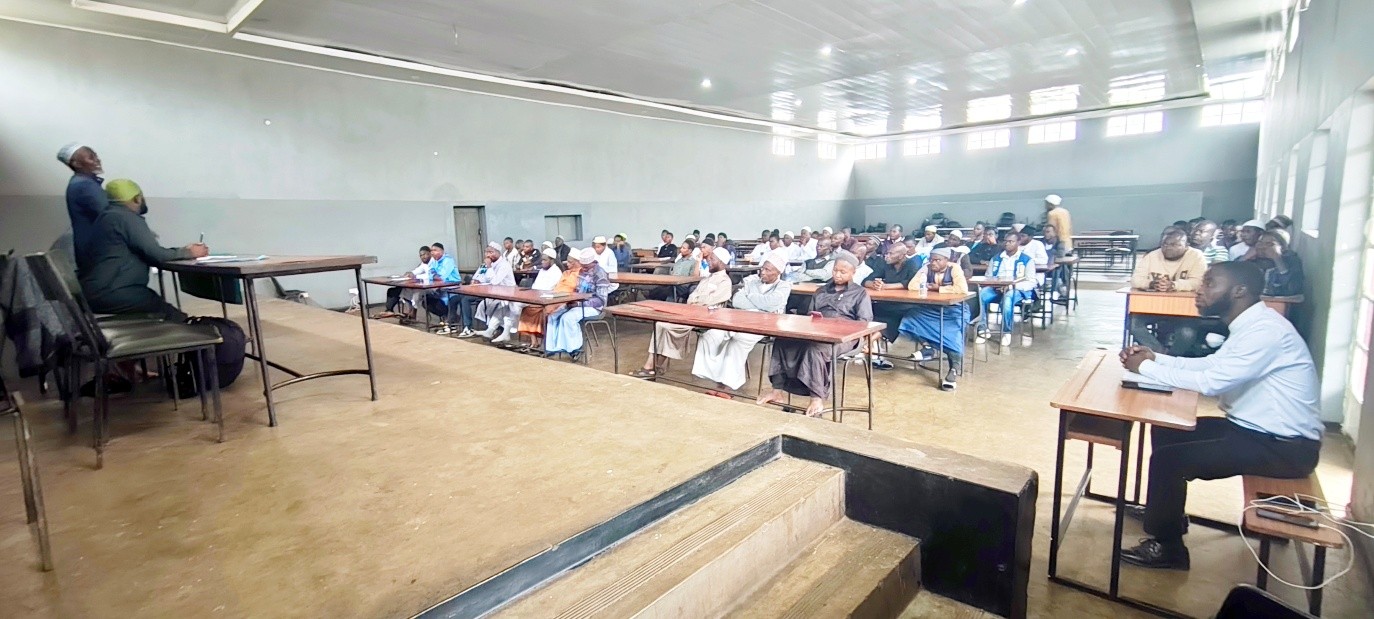
Sheikh Muhammad Silika speaking to the HD staff at the annual joint meeting
Islamic scholars in Malawi have been called upon to apply wisdom (Hikma) in supporting the work of the Halaal Department (HD) and to refrain from actions that may create confusion within the Muslim community.
Speaking at the Blantyre Islamic Mission during the Halaal Department’s annual joint meeting held from 3rd to 5th April 2026, Sheikh Muhammad Silika, one of the signatories to the department’s certification, emphasized the importance of unity and clarity on matters of Halaal and Haraam.
He noted that Islamic teachings clearly distinguish between what is permissible (Halaal), prohibited (Haraam), and doubtful, and cautioned against individuals with limited knowledge issuing misleading guidance. Sheikh Silika observed that, historically in Malawi, it was widely accepted that meat slaughtered by non-Muslims is not Halaal, a position that has only recently been challenged, largely through social media narratives.
Reaffirming Shariah principles, he stated that Muslims are prohibited from consuming meat slaughtered by non-Muslims or without the invocation of the name of Allah. He further clarified that the term Ahl-Kitab (People of the Book), as mentioned in the Qur’an, refers specifically to those who lived during the time of Prophet Issa – the Son of Mariam (Peace be upon him) and upheld pure monotheism. He advised scholars promoting contrary views to seek further knowledge before addressing the public.
On the issue of consuming hyenas, Sheikh Silika explained that it is not a matter requiring widespread debate. He noted that only certain types of hyenas, those found in desert regions and feeding primarily on vegetation which may be considered permissible. However, hyenas commonly found locally are carnivorous and therefore not Halaal for consumption.
Addressing a question on whether Muslim women may slaughter animals, he stated that while the responsibility generally rests with Muslim men, women are permitted to perform the act when necessary. He added that this ruling is based on guidance from the noble Prophet Muhammad (ﷺ), which recognizes the permissibility of such circumstances while maintaining the primary role for men.
 Posted in